
Why I Wrote This Comparison
I have been in the lightning protection and grounding industry for over a decade. Every week I speak with overseas buyers — electrical contractors, substation engineers, telecom project managers — deciding which ground rod material to specify. The first question is always about upfront cost. But after 12 years helping clients source everything from copper clad rods to exothermic welding materials, the rod with the lowest counter price is not the most economical over the life of the installation.
This article breaks down the real cost per installed meter for three ground rod types: copper clad steel (CCS), pure copper, and hot-dip galvanized steel — based on material cost, installation factors, corrosion rates, and service life data we track at SHIBANG. If you are an engineer writing a specification or a procurement manager comparing quotes, this is the data you need for a decision that holds up over the full design life of your installation.
The Three Ground Rod Materials at a Glance
1. Copper Clad Steel (CCS) Ground Rod
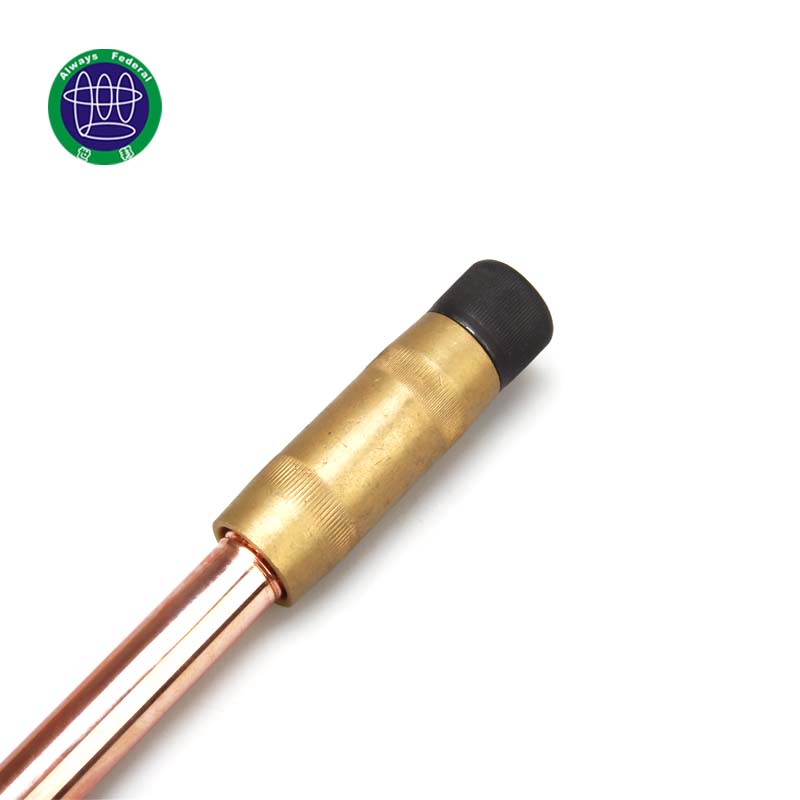
Copper clad steel rods consist of a high-strength low-carbon steel core (carbon content ~0.15%) with a copper layer bonded via electroforming. The copper purity is ≥99.95%, and the standard layer thickness is ≥0.254 mm. At SHIBANG’s copper clad steel ground rod line, diameters range from 14.2 mm to 25 mm (5/8″ to 3/4″), lengths from 1.2 m to 3.0 m, and tensile strength ≥580 N/mm².
I still remember standing next to our electroforming line at SHIBANG’s factory, watching a batch of 16 mm CCS rods emerge from the plating tank. The operator checks every rod with a magnetic thickness gauge — a handheld device that reads copper layer thickness by measuring magnetic attraction through the copper. One batch was flagged because the gauge read 0.248 mm at the driving tip — just 6 microns below the 0.254 mm spec. The entire batch went back for rework. That discipline matters when a rod ends up in coastal clay on the other side of the world.
The copper layer provides corrosion resistance and conductivity of pure copper at the surface, while the steel core delivers mechanical strength for driving into dense soil. The copper-to-steel bond is tested by bending the rod 90° at a radius of 100 mm with no fracture or delamination. Service life in typical soil exceeds 50 years. This combination is why CCS is the default earthing specification worldwide.
2. Pure Copper Ground Rod
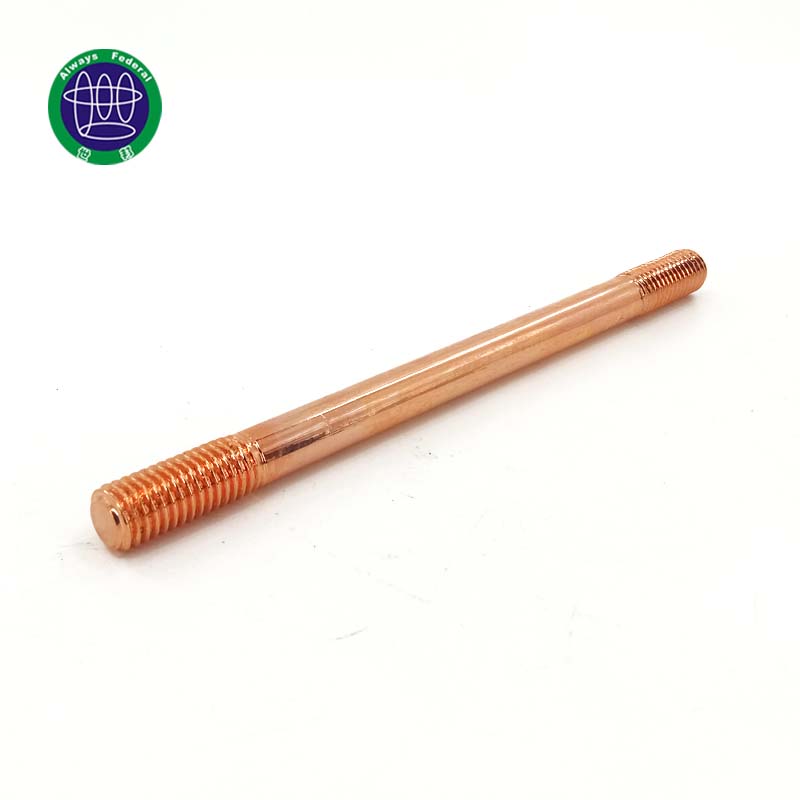
Pure copper rods use T2 copper (≥99.95% pure). At SHIBANG’s pure copper ground rod page, same diameter and length options as CCS are available. But copper is significantly more expensive than steel on a per-kilogram basis. A solid copper rod delivers the lowest resistance for a given diameter, with excellent corrosion performance in aggressive soils. However, pure copper is soft — driving into rocky or compacted soil risks bending or mushrooming the end, which is why many contractors pre-drill pilot holes. That extra labor adds to the already higher material cost.
A contractor from Manila once called me, frustrated that the galvanized rods on his hillside telecom tower had rusted through after only 4 years in coastal clay. The replacement required excavation around an active concrete foundation. The labor alone exceeded what the CCS rods would have cost upfront. “I should have paid attention to the salt spray data you showed me,” he admitted. That call stuck with me — it’s why I ask every client about soil conditions first.
3. Hot-Dip Galvanized Steel Ground Rod

Galvanized steel rods are low-carbon steel with a zinc coating applied through hot-dip galvanizing. The zinc layer provides sacrificial protection — it corrodes first, protecting the underlying steel. At SHIBANG’s galvanised ground rod product line, these rods share the same dimensions but carry the lowest unit price among the three options.
The zinc coating thickness typically ranges from 55 to 85 µm. In neutral pH soil with good drainage, a galvanized rod can last 15–25 years. But in acidic soil (pH below 5.5) or saline environments, the zinc layer can be consumed within 5–8 years, after which the steel core corrodes rapidly. I have seen galvanized rods pulled from coastal projects after only 6 years with the zinc completely gone. We run every batch through our salt spray chamber at 5% NaCl for 72 hours minimum — that test reveals pinholes in the zinc coating that no visual inspection would ever catch.
Galvanized steel rods do have legitimate applications. Temporary construction grounding, short-duration projects (5–10 year design life), and dry inland areas with neutral pH soil are all reasonable use cases. I advise buyers not to specify galvanized for permanent installations in areas with annual rainfall above 800 mm, coastal zones within 15 km of saltwater, or industrial environments with chemical exposure. Our galvanised ground rod is a solid product when the application fits.
Ground Rod Cost per Installed Meter: The Numbers
Below is a relative cost comparison based on our export data at SHIBANG and installation feedback from clients across Southeast Asia, the Middle East, Africa, and South America.
| Cost Factor | Copper Clad Steel | Pure Copper | Galvanized Steel |
|---|---|---|---|
| Material cost per 1.5m rod (14.2mm) | Medium | High | Low |
| Installation labor per rod | Low | Medium–High (pilot hole often needed) | Low |
| Coupler/connector cost per joint | Low | Medium | Low |
| Typical service life (neutral soil) | 50+ years | 80+ years | 15–25 years |
| Service life (acidic/saline soil) | 30–50 years | 60+ years | 5–10 years |
| Estimated cost per installed meter (2.4m depth, neutral soil) | Medium | High | Low |
| Lifetime cost per meter (50-year horizon, neutral soil) | Medium | Medium | High (includes replacement) |
Key takeaway: CCS rods cost about the same per meter as galvanized steel when replacement over 50 years is factored in — and they save you the labor of digging up corroded rods. Pure copper only makes sense when the owner requires zero-maintenance life exceeding 60 years or when soil is too aggressive even for CCS cladding.
Installed Cost Breakdown by Material
Copper Clad Steel — The Balanced Choice
The 0.254 mm minimum copper cladding provides corrosion resistance close to pure copper for the first several decades. The steel core makes it stiff enough for direct driving without pre-drilling in most soils. Threaded couplers allow joining multiple sections to reach depths of 6 m or more for high-voltage substations. The copper clad steel ground rod straightness error is ≤1 mm/m — critical when driving deep, because a bent rod deviates underground.
I tracked projects where CCS rods were inspected after 15 years in coastal clay. The copper cladding remained intact across 95+% of the surface. Localized scrapes from driving showed only superficial rust on exposed steel. The rod was still fully functional. That real-world performance is why CCS accounts for 80% of our export orders, backed by ISO 9001:2008 certified manufacturing at our factory.
Pure Copper — When Material Cost Is Secondary to Lifetime
I sell fewer pure copper rods than CCS, but the buyers who choose them have specific reasons. Offshore platforms, coastal desalination plants, and chemical facilities often specify pure copper because the maintenance window is extremely narrow — if a rod fails in service, the cost of shutting down production to replace it is astronomical.
In a 3-rod array at 2.4 m each, choosing pure copper over CCS adds a premium that is negligible for a major substation but harder to justify for a small telecom tower. Our pure copper ground rod is produced from T2 copper ingots with full material traceability, and we provide mill certificates with every export shipment. Every rod goes through visual and dimensional inspection before packing — I insist on this because a pure copper order is a significant investment, and the buyer needs to know exactly what they are receiving from the first rod to the last.
Galvanized Steel — Lower Upfront Cost, Higher Lifetime Cost
I want to be honest about galvanized steel because I have seen too many projects where the initial cost-saving decision led to expensive repairs a decade later. The table above assumes one replacement in 50 years, but replacement cost goes beyond the rod itself — excavation, re-driving, re-connection, and testing. In developed markets, labor alone can exceed the rod cost several times over. Our galvanised ground rod is a solid product, but only when you know the application fits.
Factors That Change the Cost Equation
Soil Resistivity
Soil resistivity is the single biggest variable. The IEEE 81-2012 standard provides measurement methods. A rod in 100 Ω·m soil (typical loam) achieves a fraction of the resistance of the same rod in 1,000 Ω·m soil (dry sandy gravel). Lower-conductivity materials like galvanized steel may need more rods or deeper driving to meet the target, eliminating any upfront cost advantage. I always ask clients for soil resistivity data before recommending, because this single parameter shifts the optimal choice entirely.
Driving Conditions
Rocky soil changes the economics. If the contractor must pre-drill, labor costs increase for any rod type. Pure copper is the most affected because it bends more easily — I once had a shipment returned from a contractor in Kenya who tried to drive 20 mm solid copper rods into laterite and bent three rods within the first 50 cm. CCS rods handle impact much better because the steel core absorbs hammer energy without plastic deformation. For soil with significant rock content, we recommend starting with a sectional CCS rod fitted with a hardened driving tip. It adds a small upcharge per rod, but it prevents the most common installation failure we see across our export orders.
Code Requirements
National electrical codes treat ground rod materials differently. The NEC (NFPA 70) in the US requires a resistance to ground of 25 Ω or less for a single rod. European standards under IEC 60364 specify minimum copper-bonded thickness for permanent earthing. The IEC 62561-2 standard covers requirements for earth electrodes in lightning protection systems. Checking local code requirements is essential, and I help our clients navigate these as part of pre-sales support.
How I Approach Ground Rod Selection for Our Clients
When a new client contacts me with a ground rod inquiry, I ask three questions:
- What is the soil type and resistivity? — If they lack a survey, I estimate based on regional geological data.
- What is the design life? — Substations and telecom towers need 30–50 years. Temporary sites may only need 5–10.
- Is the grounding system accessible? — Buried under concrete is permanent; rods in an accessible pit can be tested and replaced.
Based on their answers, 8 out of 10 times I recommend copper clad steel ground rods. For extreme corrosion risk or very long design life, I recommend pure copper ground rods. Galvanised steel rods are reserved for temporary installations or budget-constrained projects where the owner accepts replacement risk.
Beyond the rod, the grounding system includes couplers, exothermic welding materials, grounding conductors, and test clamps. Our Ground Rod & Earth Rod category page covers these. I have also written about copper bonded threaded rods for building applications and high tensile steel bars for earthing systems as companion resources for engineers designing complete grounding solutions.
FAQ
About the Author
Jane Yang is a Sales Manager at Xinchang Shibang New Material Co., Ltd., with 12 years of experience in lightning protection and grounding foreign trade. She specializes in supporting overseas clients with sourcing lightning protection and grounding products from China, covering full services including quality inspection, logistics arrangement and all export documentation. Professional, reliable and easy to communicate with, Jane is ready to offer one-stop procurement solutions for earthing and lightning protection systems worldwide.
Post time: Jul-20-2026